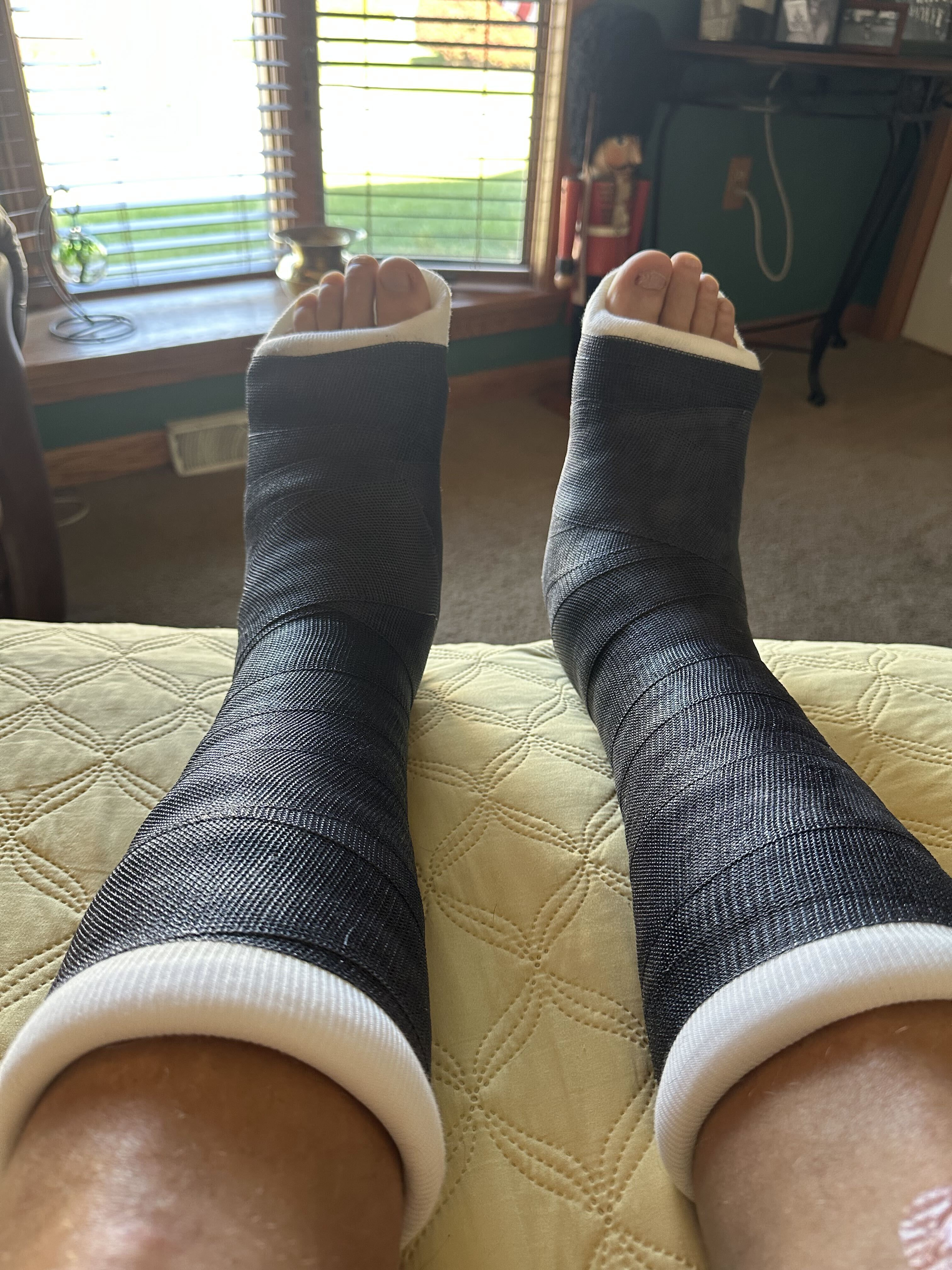
It is commonly stated that climbing is an inherently dangerous sport. This should never be taken lightly. Injuries of some sort are often experienced by most climbers at some point., whether it be a sprained ankle or a hand or shoulder tweak. On occasion, more serious injuries do occur. However, to most of us, the risk is worth the reward and we climb on. I recently experienced serious injury while climbing that put me in a situation most climbers hope never happens.
In October of 2026, I went west to do some sport climbing with a friend in New Mexico. The weather was perfect. The rock was dry and in the shade and the routes were phenomenal. The day took a turn for the worse when, after clipping the first bolt and ascending to the second, I lost my grip and took a fall from the worse possible position. The first draw was approximately 15 feet off the ground and the second was about 10 feet above that. A factor two fall resulted in what I would later learn were a broken talus in my left foot and a fractured calcaneus in my right … two broken feet. I knew they were broken at the moment of impact.
Although I did not deck, I landed on a lip of rock, dorsal flexing both my feet back toward my shins. My partner lowered me the remaining way to the ground and I sat there realizing I would, more than likely, not be able to walk. By nature, I perform well under pressure and remained calm. I removed my climbing shoes and my partner and I discussed our options. The approach to the crag had only been about half a mile and had taken about fifteen minutes to hike in. We felt that calling for a rescue would take considerable amount of time and given the location would be difficult to traverse with a stretcher. It was decided that attempting to extricate ourselves would be the fastest course of action.
The hardest part would be crossing the talus field and getting through a few large boulders at the base of the crag. Initially I was able to walk a bit, although in quite a considerable amount of pain. Utilizing a branch and my partner for support we made it to the trail ready to descend. By this point pain and swelling prevented any further attempts at walking out and the long slog began.
From a seated position, I scooted my body forward about ten feet at a time. That became my goal, just get ten more feet. Over the course of the descent, I quickly learned what worked and what didn’t. The gravel on the path began to cause pain in my tail bone and palms and rest and water were required. My climbing partner kept up the encouragement and we were both dedicated to making it down. We continued like this the remainder of the way, every so often cursing the fact that it had to be both feet and not just one. The car was in sight and got closer and closer with each ten foot repetition of scooting.
An approach that had taken approximately fifteen minutes on the way in, took three hours to scooch out. By this time, I was exhausted, dehydrated, in pain, and relieved to had made it back the parking area and was taken directly to the hospital. The left required immediate surgery to repair and the bones in the right, although fractured, were in place. I wouldn’t be walking for a while.
I have had a great deal of time to think about the experience, particularly since I now sit here, immobile, with two casts. Although experiencing what I consider as the most physically demanding experience of my life, I believe we made the right choices and were able to reach aid in the timeliest manner.
To those that every find themselves in such a predicament, I give the following advice.
Plan ahead. Be prepared for any eventuality. Have sufficient water and supplies. Carry a first aid kit and consider how you would escape in a worst-case scenario
Remain calm. No doubt your body will be in some level of shock. Stay grounded and make good choices
Consider your options. Calling on Search and Rescue for extraction was definitely an option, however it may have been difficult to get a stretcher up and out of the location and an air lift would have taken a considerable amount of time. I had always learned that if you can self-rescue, it’s the most efficient course of action before involving SAR and that is what we opted to do. We were not in the wilderness and the car was in view, although from my perspective a daunting distance away.
Make small goals. No matter how hard the task, break things up in to smaller achievable goals. Make incremental progress. In this case, I resolved myself to move ten feet and then regroup. This made the progress manageable
Stay Positive. Keep a positive mental attitude. A defeated mindset leads to defeat.
Breathe. Traumatic injury increases the heart rate. Slow controlled breathing reduces the heart rate, provide more oxygen to the system, and helps to manage pain.
I have personally had a considerable amount of training when it comes to dealing with back country emergencies over the years and would recommend a Wilderness First Aid (WFA) course to anyone that participates in higher risk activities in secluded areas. All professional guides certifications require a WFA certification as well. This is an added benefit of hiring qualified individuals in addition to their climbing expertise and knowledge. Being prepared for any eventuality allows you to more confidently and safely pursue the things you enjoy. No one goes into a day of recreation expecting to have to deal with an emergency, but knowing what to do if one occurs can prevent further injury and save lives. For those interested WFA courses are offered around the country throughout the year by providers such as The American Red Cross, NOLS, or WFA International.
I hope this does not dissuade anyone from the sport of rock climbing, but rather gives perspective into what to do when things don’t go as planned. Climbing is an inherently dangerous sport and we should all know the risks. Knowing how to handle an adverse situation enables us to live to climb another day.