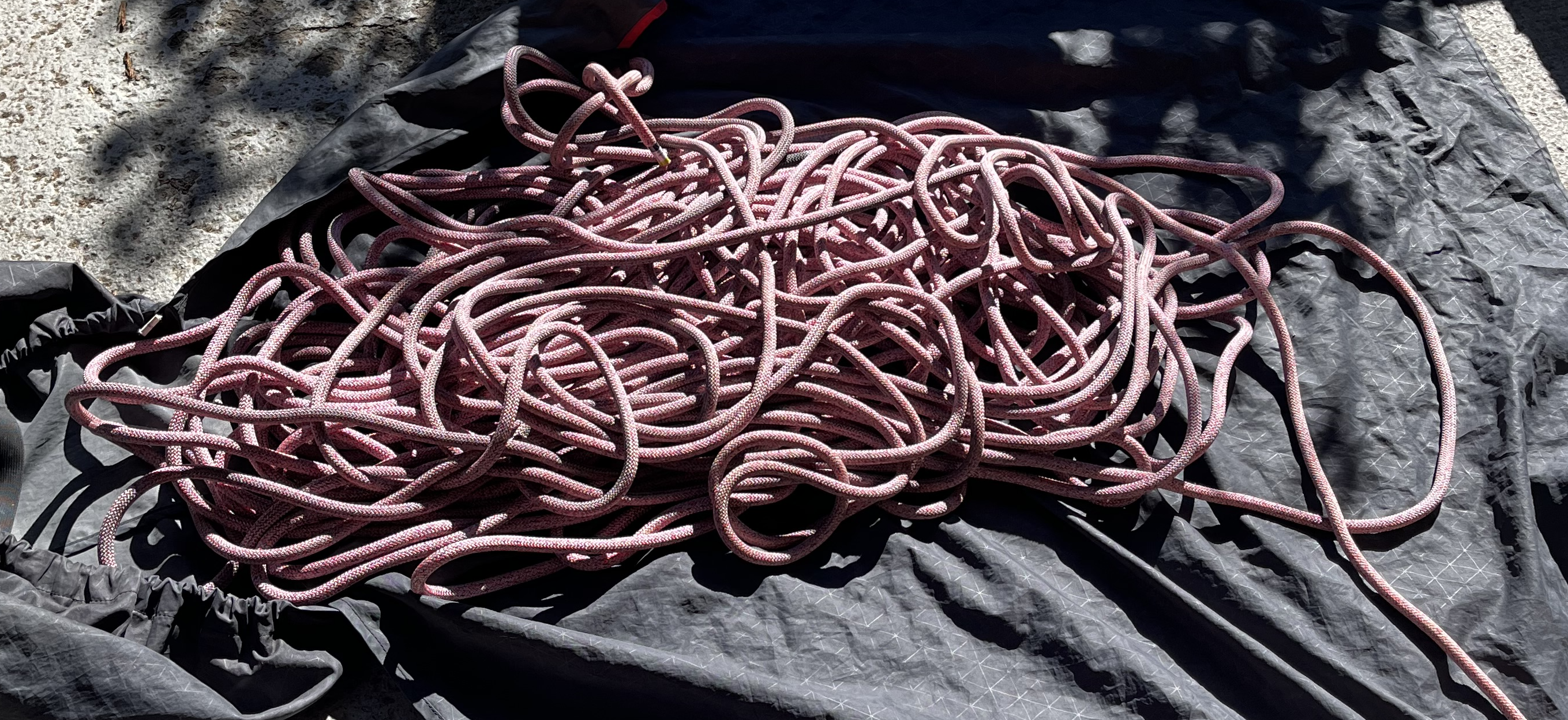
Not just any rope— not a hemp rope, not a rope you would tie a Christmas tree to the top of your car with, not a rope you can hang your laundry on. Rather, climbing ropes are made with “perlon” and consist of a braided core of the stuff encased by a woven sheath. This skinny thing—around 9 millimeters thick and 60-70 meters long—saves a climber’s life over and over and over and over again, and so it follows that they are “extremely reliable,” as long as they are well kept and don’t have any flaws.
The international organization called Union Internationale des Associations D’Alpinism (UIAA), set up standards that every rope should meet before it is sold. The test that the UIAA has developed is “more severe than any fall you could possibly take in the field… Indeed the UIAA simulated fall is so severe that it’s about like tying off a dairy cow and marching her off the cliff’s edge for a 300-footer,” according to John Long who has written every version of the book, How to Rock Climb!
If you aren’t toproping, the first climber up is called the lead climber. Tied to the lead climber, the rope accompanies her, and she connects it to safety equipment in the rock along the way. The rope is part of the safety system that connects the climber to the belayer and represents the belayer’s promise to keep the climber from falling to the ground. The rope becomes something that others can follow through the labyrinth of holds. The rope is a reminder that someone has been there before, that there is a way up, as well as a safe way back down to the ground.
Ropes for toproping-only can be static— they don’t need to stretch much. Lead ropes are dynamic, though, which means that they stretch in order to absorb the force of a fall, keeping the climber from absorbing that force into their body and damaging their spine. Sometimes they are dry in that the sheath, which can be woven in different colors and patterns, is coated with silicone or fluorochemicals to improve the integrity and longevity of the rope, though not necessarily making them completely waterproof.
Because of the dry coating, when the rope runs through carabiners and belay devices made of aluminum-alloy, a black residue builds up on it and then gets on your hands when you touch it. I hate to handle a dirty rope. It makes me shiver, which is why I wear gloves when I belay. Sometimes the rope is so covered with this metallic film that, when it brushes against my arm or leg, it leaves a mark behind. When I am lead climbing, and I pull rope up to clip a bolt, I put the rope in my teeth momentarily if I need more than one arm’s length of it. This means I get black streaks on my face too. I don’t like these smudges because they make me feel gross, but in another way, I do like them because they mark me as a rock climber. So when I walk into a gas station after a day of climbing outside, all sweaty and dirty with chalk all over my clothes and black streaks on my body, too, I feel distinct, different, cool— but I still find the restroom so I can wash my hands and wipe my face.
The importance of the rope to the life of the climber means that you need to take great care of it. Even though the rope may have a dry coating on it for protection, dirt and residue can still eventually break down its integrity, so every once in a while, the rope needs to be cleaned. Just throw it in the washing machine like any dirty laundry and then let it air dry. It is also important how you store it. You can’t just let the rope hang out all over the place to get tangled and exposed and stepped on. Enter the rope bag accessory. Rope bags used to just be bags to flake your rope into— a large nylon stuff-sack with a draw-string closure at the top— or a plain-old tarp to wrap your rope up like a burrito. A more modern rope bag is a combination of a tarp to wrap your rope up like a burrito, and a sack into which you stuff the whole thing. Cinch it up tight with some nice webbing straps and buckles, and the little bundle slides easily into your pack.
Rope bags are meant to keep your rope tidy both when you are using it and when you are not. However, you often end up enclosing a bunch of stuff— pebbles and sand and leaves and twigs and possibly a tiny spider, say— that made its way into the bag while you last used the rope because you weren’t careful enough. Maybe you had to pack up in a hurry because it was getting dark or it started to rain. You forget about the dirt until the next time you open it up at the crag, and you have to shake out all that crap and reflake the rope before you start climbing. Opening up a rope bag months after a climbing trip to find dirt in there from another state— Utah or Kentucky or Oregon or Wyoming— can be like opening a gift. For a moment or two, those old relics can transport you to another place and time, reminding you of rock climbs you vanquished or, just as likely, that vanquished you.