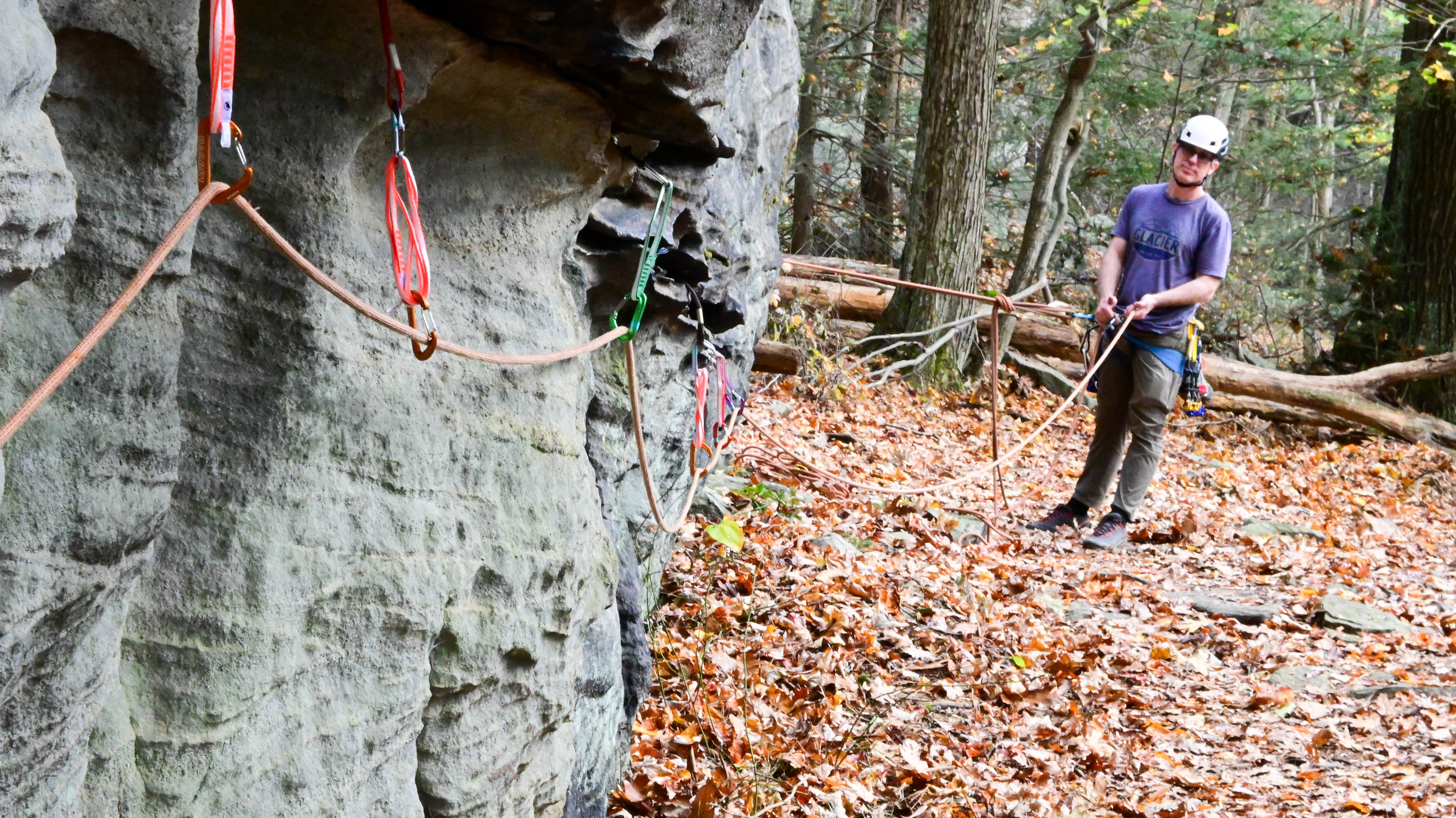
I recently had the privilege of attending a two day course with ASCEND on building trad climbing anchors. The course was taught by Scott Roman and Jeff Baxter. The course was excellent and I recommend it to anyone interested in trying trad climbing or who just wants to enjoy a fun weekend with other climbers! After the course, I continued working over several topics in my mind to ensure I had learned what I needed to learn. A wise person once said, “if you can’t write it down, you don’t understand it” so I wrote the rest of this to ensure I did.
Physics for Climbers
In traditional (“trad”) climbing, the climber places protection to hold their weight in case of a fall to prevent them from hitting the ground and other objects. This leads us to a number of potential questions and how much force the protection needs to be able to withstand in different situations. This essay will not use complicated mathematics and is intended to be presented in a way climbers can refer to in their heads at a crag.
Energy
We can think of two types of energy, potential energy and kinetic energy. Potential energy is stored; kinetic energy is in motion. Climbing up a cliff increases potential energy. Falling converts that potential energy to kinetic energy. Kinetic energy is where we can get hurt.
The higher the potential energy the higher the risk. In simple math:
Potential energy = mass X height above the ground X acceleration from gravity
We can’t significantly change our mass or do anything about gravity, so our potential energy is directly proportional to our height above the ground. That is the variable we control.
The greater the potential energy the more we need to do to prevent it from turning into kinetic energy. This is why we have climbing gear. We want the climbing gear to prevent and limit falls and in the case of a fall, to absorb the energy so our bodies don’t.
Climbing is energy management.
Force
What is force? As we use the term in climbing, force is the pull of gravity downward on our bodies and the corresponding push of the rock or ground on us if we fall that can cause us to change speed, direction, or shape (e.g., cause injury). Force has both a size and a direction. While gravity pulls us downward at all times, our rope can pull us in any direction. Force is measured in a unit called Newtons (N). We normally speak in terms of “Kilo Newtons” (kN) where 1000 N = 1kN.
But how much is 1kN? Most of us grew up referring to force in units of pounds (or more specifically “pounds-force.”) 1kN ~ 225 pounds. We can therefore usually make a conservative assumption that 1kN ~ a person (but be aware that if you are climbing with a person who has more mass than this assumption you will have to adjust accordingly.)
A 1kN (225 pound) person falling ten feet to the ground is moving at 17 mph when they hit. If we assume that the ground compressed a centimeter when they hit, they would strike with a peak force of over 300 kN. If they hit rock (that isn’t going to compress), the forces become much higher.
If a climber strikes the ground or rock with sufficient force, they can become injured. How much force does that take? Now we have to acknowledge that real life is more complex than we want to calculate or model, so let’s keep our assumptions simple and ignore all the twists, turns, angles, ages, genders, padding and other variables that can be involved. Let’s just ask, in general, how much force is necessary to break a bone or rupture a ligament.
According to Emergency Room data, half of climbing accidents (falls) involve injuries to the lower extremities (legs, ankles, and feet), a quarter the upper extremities (arms and hands), and remaining quarter the torso and head.
BONE | FORCE TO BREAK |
Femur | 4kN |
Tibia (shin bone) | 1-2 kN |
Tibia (axial) | 9-12 kN |
Fibula | 0.2 - 0.45 kN |
Toes | 1 - 4 kN |
Phalanges in the Feet | 0.2-0.5 kN |
What about connective tissue? The Achilles tendon will rupture with about 4-5 kN of force. The Anterior Cruciate Ligament (ACL) in our knees will tear at about 2.2 kN of force.
Sudden stops impart massive forces on our bodies. We don’t want our bodies acting as shock absorbers in climbing accidents and feeling those forces. It just doesn’t take much force in the wrong location at the wrong time to injure a person. Athletes learn how to move within their sport to minimize these forces (minimize injury). Climbers need to practice falling in safe and controlled situations to maximize their ability to absorb impact and reduce the forces on their joints and bones.
I’m not a medical doctor, but at this point we can see that our bodies can break before our climbing gear does. So while we all need good climbing equipment used in the proper manner, what we really need to do is to keep the forces on our bodies safely below the injury threshold.
Forget about instagram videos of large whips. That is never the goal. The goal is to enjoy climbing and keep our group safe so we can continue to enjoy climbing. We can use a simple understanding of physics in climbing to help us prevent injury.
The Physics of Rope Systems
If we fell with static ropes there would be no gradual shock absorption. Dynamic ropes stretch to slowly absorb the forces and allow softer falls. As the rope stretches it decelerates the fall allowing the climber to experience lower forces on their bodies.
So how does a dynamic rope work? Dynamic ropes can stretch about 30% (check your rope for the exact numbers, there is some range to this). So if the distance from your belayer to you is 10 feet, and you fall, your rope could be as long as 13 feet when you stop falling. If there is 100 feet of rope between your belayer and you, and you fall, your rope could be 130 feet long when you stop falling.
Dynamic ropes are tested by placing an 80 kg (176 pound) weight on the rope to measure the static stretch. The stretch needs to be under 10%. Higher weights will produce more stretch.
The same 80 kg mass is then connected to the rope and dropped. The rope is allowed to stretch up to 40% on the first fall. Fully kitted up for climbing, I weigh about 80 kg so I appreciate these tests!
Rope stretch can be both good and bad depending on the situation, so let’s talk it through:
Rope Stretch: The Good
The more rope between the belayer and climber the more shock absorption is in the system and lower the forces will be in a fall. Ideally falls don’t happen at all, but if they do we would want the shortest fall distance with the most available rope.
This effect is described as the fall factor:
f=h/L
Where f = the fall factor, h = the fall distance, and L = dynamic rope length between the belayer and climber.
If we want the fall factor to be low, then h needs to small and L needs to be large. If L is small (because it is early in the climb) then h really needs to be small.
Some examples. If a climber is climbing on a top rope on a tight belay and falls, what is the fall distance? It should be nearly nothing. If h is nearly 0 then the fall factor is 0. This fall is very soft and gentle.
What if a climber is leading and falls a distance equal to the length of rope paid out (e.g., falling when the last piece of protection is at waist height)? This would be a factor 1 fall. For example, falling ten feet with ten feet of rope between the belayer and the climber.
f = h/L = 10/10 = 1
The maximum fall factor would be in a situation where a climber started from a belay ledge, climbed any distance (say 10 feet) and fell the entire length of the rope, falling past and below the belayer (10 feet below the belayer with a 20 foot fall). This is a factor 2 fall and produces the highest forces on both the climbing gear and the climber.
f = h/L = 20/10 = 2
We want to avoid a factor 2 fall by placing one or more pieces of protection soon after starting a climb from this position.
The severity of a fall depends on the fall factor rather than the absolute distance fallen (a 4- meter fall on 2-meters of rope has the same factor 2.0 severity as a 40-meter fall on 20-meters of rope) because the fall factor considers both the fall distance (or the force) and the amount of rope in the system (or the ability to absorb and decelerate the force).
Rope Stretch: The Bad
A factor 1 fall generates approximately 5.5 kN to 7.0 kN of peak impact force on the climber and last piece of protection. That is still enough to break a bone so falls should be avoided. A factor 2 fall generates approximately 8.0 kN to 10.5 kN of peak impact force on the climber. Factor 2 falls should be prevented.
If the last piece of protection on a climb was a small (micro) nut which has a rating of 2 - 7 kN, we can see that the difference between a factor 1 and factor 2 fall is likely to be the difference between the nut holding or failing. If the protection doesn’t hold the climber, they will fall to their next piece of protection increasing the risk that they hit the ground, or hit the wall awkwardly.
What about small cams? Let’s say the last piece of protection was a 0.1 Black Diamond Z4 microcam which can hold up to 5 kN if placed properly in clean, dry, solid rock (poor placement technique, wet, dirty, or loose rock can be much less). You can safely hang from it, but you cannot take a factor 2 fall on it. You likely can’t take a factor 1 fall on it either. Several accidents have occurred when climbers have taken whips on small gear and the forces exceeded the ratings, the gear blew out, and the climber fell further causing an impact with an unyielding surface.
In this situation more than one piece of gear should be used and the loads equalized between the gear.
Rope Stretch: The Ugly
Let’s say you have a climb that is 100 feet (30 meters) from the ground to the top anchor. Someone leads the route, sets up a top rope, and gets lowered down to the ground on a 70m rope. The next climber ties in to try the route on top rope. You are totally safe top roping right?
So the climber climbs up 10 meters (30 feet) with 50 meters of rope from the belayer, up to the anchors and back down to the climber when the climber reaches the crux and falls. How far does the climber fall?
The rope length can elongate: 1.30 x 50m = 65m
Since the distance from the ground to the anchor is 30m (and distance from the anchor to the ground is 30m) this means the climber can hit the ground - even if the belayer had them on a tight belay and used a GriGri that arrests the fall immediately. Belayers should prioritize a tight and attentive belay to manage rope elongation when the climber is near the ground and on a top rope to minimize the risk of a ground fall.
Best Practices
Assess your mass compared to the gear you are using. Don’t forget to include the mass of your pack, the rack around your waist, etc. Most climbers can conservatively be considered to be < 1 kN, but not always.
Always back up micro cam placements with other gear and equalize the load of a fall between the pieces. Never trust your life to a single micro piece of protection.
Place one or more pieces of protection shortly after starting a climb if you have the potential to fall past the belayer. Prevent factor 2 falls.
Always account for rope elongation. The heavier the climber and the greater the fall factor the more the rope will stretch. The more rope is in the system the greater the shock absorption but also the further they can fall as the rope stretches. Don’t let your climber hit the deck under any circumstance.