WE STILL NEED VOLUNTEER SUPPORT! This Saturday 3/28/26, ASCEND South Side is hosting a large Regional youth competition. If you're interested and able to lend a hand, we'd greatly appreciate it! LEARN MORE + REGISTER
The beauty of climbing is you just get better at it by doing it. If you come in and climb, you are going to get better. However, if you want to compete, you need to get way better way faster and then develop a mentality to withstand the pressure.
When Marston Leff started climbing at The Climbing Wall twenty-five years ago when he was twelve years old, he did three ABS (American Bouldering Series) comps. Back then, youth categories were ages fifteen and under, female and male. He went three for three, never lost a competition, and never competed against more than two other kids.
Twenty-five years ago there also wasn’t climbing training. You had to just figure it out on your own. Marston and his brother climbed at The Climbing Wall, but they also built a campus board in their garage.
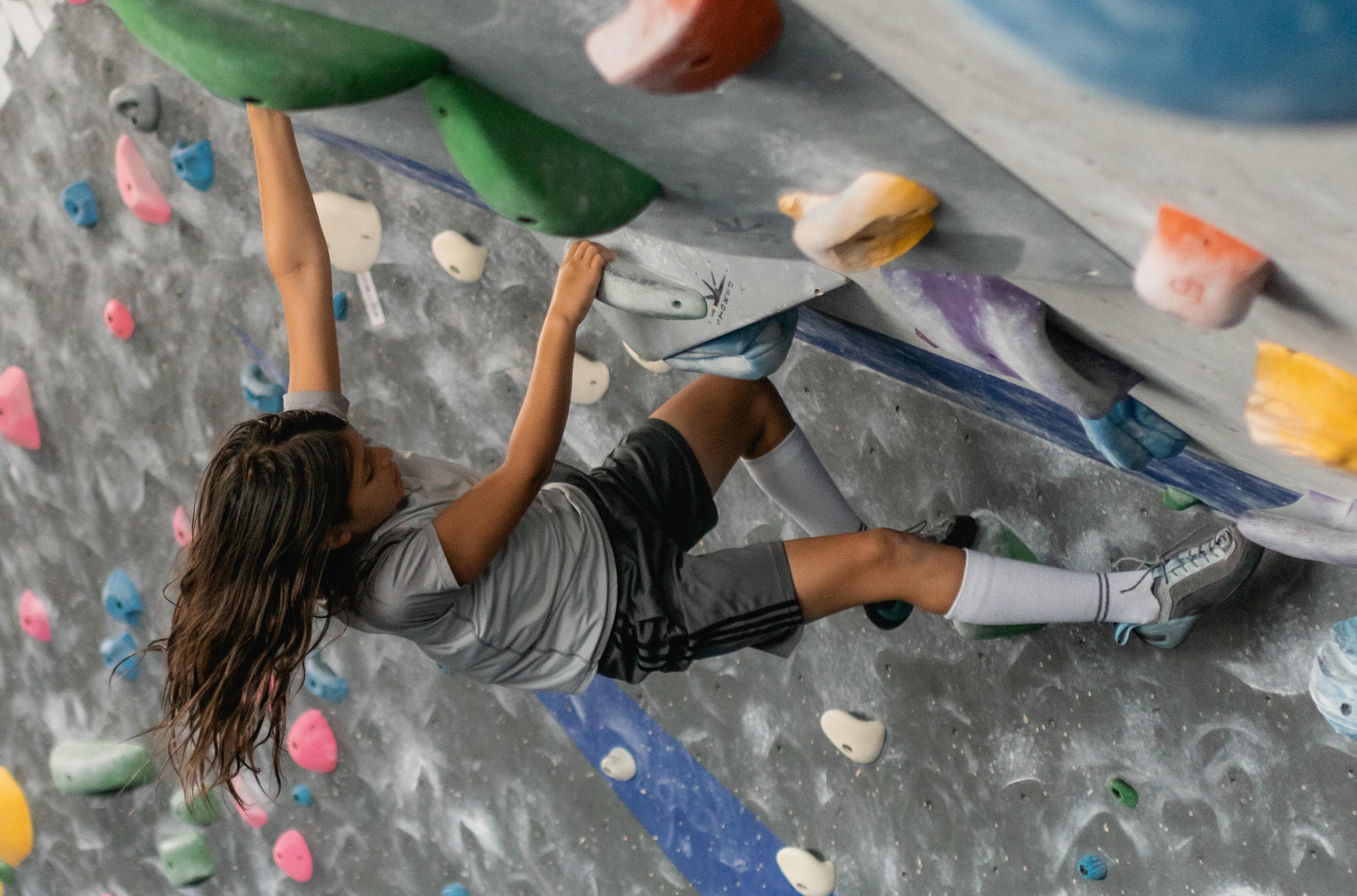
These days when kids go to a youth competition, there are at least 250 kids. The energy is crazy, the difficulty is crazy, and the competitors are incredibly good climbers. Climbing is not the hardest part of youth competitions any more. It's all the stuff going on in the kids’ brains. Marston would say at least 50% of coaching the youth competition team is all the mental stuff, and then being on the wall for 8-10 hours per week, the kids get physically strong.
Marston, now the Director of Youth Programming and Climbing Coaching at ASCEND, is mostly a self-taught coach. He watches Hooper’s Beta videos that break down movement so he can talk about movement with the kids on ASCEND’s competitive climbing team, the A Team. He uses other resources as much as he can to build his own knowledge, but he is the conduit to take in knowledge and interprets how to use it with the team.
If you are coaching a competitive climbing team, you have to be certified by USA Climbing. Coaching in the USA Climbing network has improved, but there is still room for better support. There could be more resources for the local coaches. The first item in USA Climbing’s new strategic plan is “supporting and growing the climbing community in the United States." To buttress that, it would be great to see a website that houses information and resources put together by all of our amazing national-level climbing coaches.
Marston approaches his task as head coach very methodically. There are three things which need to happen between the coaches and the kids for the team to be successful:
The coaches need to build a relationship with each kid. They have to trust the coach. The coaches are going to ask the kids to climb things that may feel hard and scary to them.
The coaches need to find out how to work with each individual to expand the kids’ understanding of their own mental limits, and expand the kids’ understanding that fear is not a stopper, but that fear can be a motivator to help them push through.
Then the coaches can approach the physical strength side of climbing.
Technical climbing can always be happening under the surface. Climbers can work on technical skills on easy climbs nowhere near the climbers’ physical or mental limits. Marston and the other coaches begin by building the kids' understanding of technical skills, their understanding of the language of climbing, their mental fortitude and resilience. Then they can put it all together and start really pushing the kids’ limit grades.
Marston doesn’t just coach kids as if they are small adults. There are two differences between coaching kids versus adults that he always keeps in mind: 1) Kids are made of rubber. They recover in 10 minutes, and they don’t break. But 2) a coach has to be more creative with what is done and how things are described to kids. With adults, you can be more direct; you can have more of a rational conversation about things. With kids you have to figure out how to get them to do what you want them to do without telling them directly because they won’t understand. You can’t tell them that their hips are sagging because they don’t understand— they don’t know they have hips.
One point of measurable progress by the team as a whole has been in their upper body strength. Last year, Marston could see that the team was physically deficient in upper body strength. Along with Elliot, the assistant coach, Marston developed a push-pull workout. He used his experience doing P90X and Crimpd (a phone app for climbing training). He didn’t want to involve any heavy weights because the kids on the team are between the ages of ten and seventeen years old. He wanted them to do body weight exercises only. The team did that workout three days a week for six weeks straight, and we saw a massive growth in upper body strength, the ability to do push-ups, pull-ups and dips in all the kids.
Once the team built up that strength, Marston could give the kids confidence in their own ability. The coaches know the kids are stronger and want the kids to know that they are stronger. When Marston sees a kid on a climb and sees them letting go, he can tell them that they are hitting a mental, not a physical block. The likelihood that a kid is hitting against their physical limits is pretty low. It’s almost always a mental limit that they’ll hit first, and it takes a year or two or three to tackle and bring those under control. By then Marston finally has a good sense of where the kids’ physical limits are, and the coaches can start working with the kids to push past their physical limits on the wall.
Youth competitions are either bouldering or lead climbing. The team began competing in lead climbing when ASCEND Point Breeze opened in 2022. Another point of improvement in the past year or so has been in the team’s lead climbing abilities, which is a sign of growth in mental fortitude. ASCEND had a Rock Warriors clinic a while back, which, very basically, trains climbers to deal with fear of falling when lead climbing. Marston took the clinic and then adapted it for the youth team. Before that, one of the smallest kids on the team wouldn’t get on a lead rope, but as a result of the adapted Rock Warriors training, he’s now one of the best sport climbers in the gym and the team has 35-50 lead-climbing certified youth.
This year Marston is also very impressed with the development he has seen in the attitude that the kids bring with them to the competitions. When the team started competing, if they couldn’t get to the top or do well on every boulder/route, many of them became understandably angry/upset/frustrated, and it affected the rest of the competition. The whole team has become much better about compartmentalizing their emotions and learning from each attempt in order to improve.
The way they train the mental side of actual comps is mainly about practice. The coaches stage mock comps that definitely help to mimic the high pressure scenarios that come with onsite comps and isolation. During practice, coaches are constantly working with kids to name and identify what emotions they are going through so that they can practice how to manage/channel those emotions. For kids it’s incredibly important for the coach to highlight that what the climber is feeling is not bad or wrong. It’s important to recognize that just like tired muscles don't function as well as fully fueled muscles, distracted thoughts detract from climbing focus in the same way.
The coaches also work with the kids on taking personal responsibility. They talk about how behavior and actions affect others. The result comes out in appropriate behavior in the gym (i.e., don't run under other climbers) and in being encouraging and building-up fellow team members, not tearing them down.