Common sense tells us that a number of head injuries that occur each year in rock climbing might be avoided through the use of helmets.
-----
[But]...avoid the tempting delusion of thinking a helmet makes you a “safer” climber than a person going au naturel. Acts of God notwithstanding, safety largely lies with the climber, not in his or her gear. —John Long, How to Rock Climb! (2010)
-----
Climbing is inherently dangerous and risky, and some of the danger and risk can be mitigated. I have never been an undue risk taker, though some may think that I am just because I climb. But Brian and I are extremely cautious folks. I would even venture to say that we are most cautious in our approach to climbing. And yet, helmets are optional when it comes to safety gear. Indeed, helmets are the only safety gear for climbing that we would consider optional.
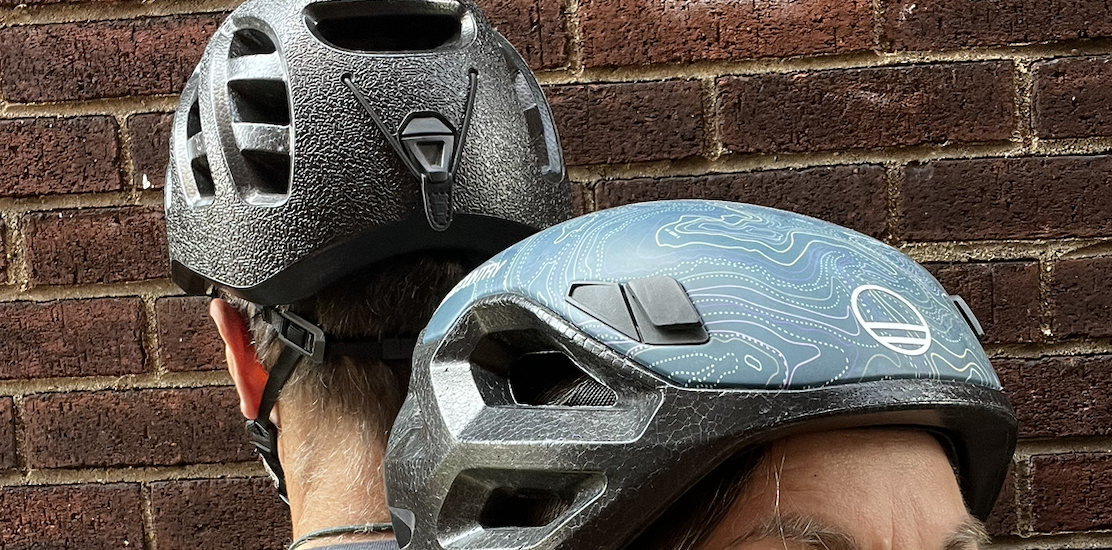
Throughout the years we have gone back and forth about whether we would use helmets or not. Just this year, we bought new climbing helmets to replace our older hard-hat kind (see below) thinking that, even if we don’t truly believe we need them to be safe, wearing them might make us feel safer, especially when climbing hard routes. We’ve become even more cautious (read: scared) in our old age.
Here is a bit of information and background:
A basic climbing helmet has a main outer layer of hard plastic which will keep a fallen object from bludgeoning you in the skull. Think, hard hat. Newer and fancier climbing helmets are mainly made of a thicker, softer plastic or foam that will absorb impact and break apart when a climber hits their head with force, say, in a rock climbing fall. Think, bike helmet. Some models combine both of these types of protection. Inside all helmets is a scaffolding of plastic and webbing straps that culminate in a buckle that clasps under the chin to keep the helmet on snugly. Most helmets have vents for breathability and comfort as well as a place to secure a headlamp. Many climbers wear helmets nowadays, and therefore, there is a wider variety to choose from depending on how much you want to spend and what you are using said helmet for.
Back in 1994, when I started climbing, the majority of rock climbers— I should say, sport climbers— did not wear helmets. When I learned how to climb at The Climbing Wall, I got the sense that cool people didn’t wear them inside ever, and only scaredy cats and trad/alpine climbers wore them outside. But you still had to sign a waiver after writing, “I have read and understand the above,” not to have to wear those old, old-school, heavy-duty plastic monstrosities in the gym.
For many years, sport climbers were intent on climbing as hard as they could with the lightest and most minimal gear possible. A helmet on one’s head did not fit into that ascetic equation. Or into an aesthetic one— helmets were not considered sexy. In those days, climbers were barely emerging (escaping?) from the space-age climbing-wear trend of gaudy, sometimes shiny, aerodynamic spandex. Climbers in the 80s and 90s often resembled a member of a hard rock or heavy metal band. Think, Twisted Sister. Probably a lot of climbers were in a hard rock band, or dearly wanted to be. Just watch Masters of Stone: Volume 1, and you’ll see what I mean.
In those days, helmets were worn primarily in case of rock fall. To shed a bit more light, here is a John Long quote from 1989:
In pure rock climbing areas like Yosemite, Colorado’s Eldorado Canyon, Tahquitz Rock in California, or the Gunks of upstate New York, you can climb for years and never see anyone wearing a helmet. The reason is that in these areas rockfall is rare, and while it is possible to injure your head in a fall, for some reason it rarely happens. Climbers have accordingly avoided wearing helmets because they feel awkward. However in the mountains, where the terrain is often anything but glacier-polished granite or dense sandstone, it’s only the certified madman who doesn’t wear a helmet. It’s your choice. If you feel better wearing a helmet, do so.
Rockfall has not been common at the larger climbing areas near Pittsburgh either, namely, the New River Gorge and the Red River Gorge, and we never saw sport climbers wearing helmets until sometime in the 2000s. Surely, climbing hasn’t become more dangerous in and of itself over the years. What could have prompted the “recent” push for climbers to protect their heads?
It could be the gradual increase of our society’s safety awareness. When I was a kid one of our cars didn’t even have seat belts, and there was no such thing as a law about wearing them; car seats like the ones for little kids today pretty much didn’t exist either. Now these things are ubiquitous.
Maybe there are more climbers putting themselves into more dangerous situations these days. Yes, but, the average/ordinary climber probably isn’t, and those who are, like Alex Honnold, aren’t wearing helmets; and if you have seen the movie Free Solo, you know he is putting himself in the most danger possible, so much danger as to make wearing a helmet moot.
Maybe since climbing has become so popular, there are more people doing it who haven’t yet learned or internalized how to fall correctly, without getting hurt, especially without the risk of hitting their heads. Flipping upside down when you take a fall is typically when you are likely to hit your head. Flipping upside down when you fall is avoidable the majority of time and requires an awareness of where your body parts are in relationship to the rope. I have flipped upside down two times in the 30+ years I have been climbing. One time, I wasn’t paying attention to where my feet were, and one of them was behind the rope when I fell and I flipped over. The other time I was on a slab, and my toes pinged off the rock when I fell and I flipped over— that was just last year. The first time was avoidable, the second time, I would say, was not. I did not hit my head either time, but it was scary.
Or maybe, more people are wearing helmets because more people are wearing helmets. Everybody’s doing it.
It wasn’t until we had a couple of kids, and they started climbing on actual routes that we began to think about helmets being something we should use sometimes— or, the kids should. I’d read an article (which I cannot find) by a woman who was belaying when her climbing partner pulled off a huge block that fell and hit her in the head, causing major trauma and some permanent brain damage. It took her a long time to recover. Her message was, since you don’t know when a freak accident is going to happen, you should always be prepared for one. The message that everyone should wear helmets all the time when climbing was gaining volume and frequency.
Because of this, I began to worry what other climbers would say to us if we didn’t put a helmet on at least our kids’ skulls when they climbed, if not our own. We were seeing more and more sport climbers out there climbing hard and wearing headgear. People we knew, even. Our friends! The questions Brian and I needed to answer for our family were, if we wear helmets are we just capitulating to herd mentality, or do we really believe that they are necessary safety gear for climbing?
Another factor that influenced our decision was, in a prior year, we’d lived through our youngest son’s relatively major head injury. He fell in our dining room and fractured his skull. For a while after that I lived in constant fear and anxiety— if something like that happened in the safety of our own home, what could happen outside? Nowhere was safe. But none of us began to wear helmets around the house. It was a freak accident after all. It made me wonder, did we really need to when climbing outside?
Our answer to all these questions was, well, it depends. It depended on the climber, and it depended on the climbing area. Brian and I were adults and could decide for ourselves, and while our kids were young and inexperienced enough, we’d decide for them. They wore a helmet when they climbed sometimes, especially in places we knew there could be rockfall, like Maple Canyon in Utah with its conglomerate, cobblestone cliffs.
With all this said, each of us did proudly own a climbing helmet for a while— the hard hat kind. Each of us picked one at the new local outdoor store before a trip to Maple Canyon in Utah with its unpredictable flying cobblestones. Knowing that the kids would want to try lead climbing and didn’t have honed falling skills yet gave us another good reason to add to the pros column of the Pros and Cons of Wearing a Climbing Helmet List. Plus buying new climbing accessories gave us all more incentive to climb.
One note of interest perhaps, the only time I’ve hit my head while climbing is when I was wearing my helmet because, well, I was wearing my helmet and it got in the way. There is no doubt that they are awkward.
So yes, there are times and places to wear a climbing helmet, and everyone has to decide when and where that is for themselves. It’s valuable to think through the reasons why or why not. It’s valuable to note that wearing a helmet is only one, small way to be safe when climbing. It’s also valuable to respect others’ decisions about whether to wear a climbing helmet or not.