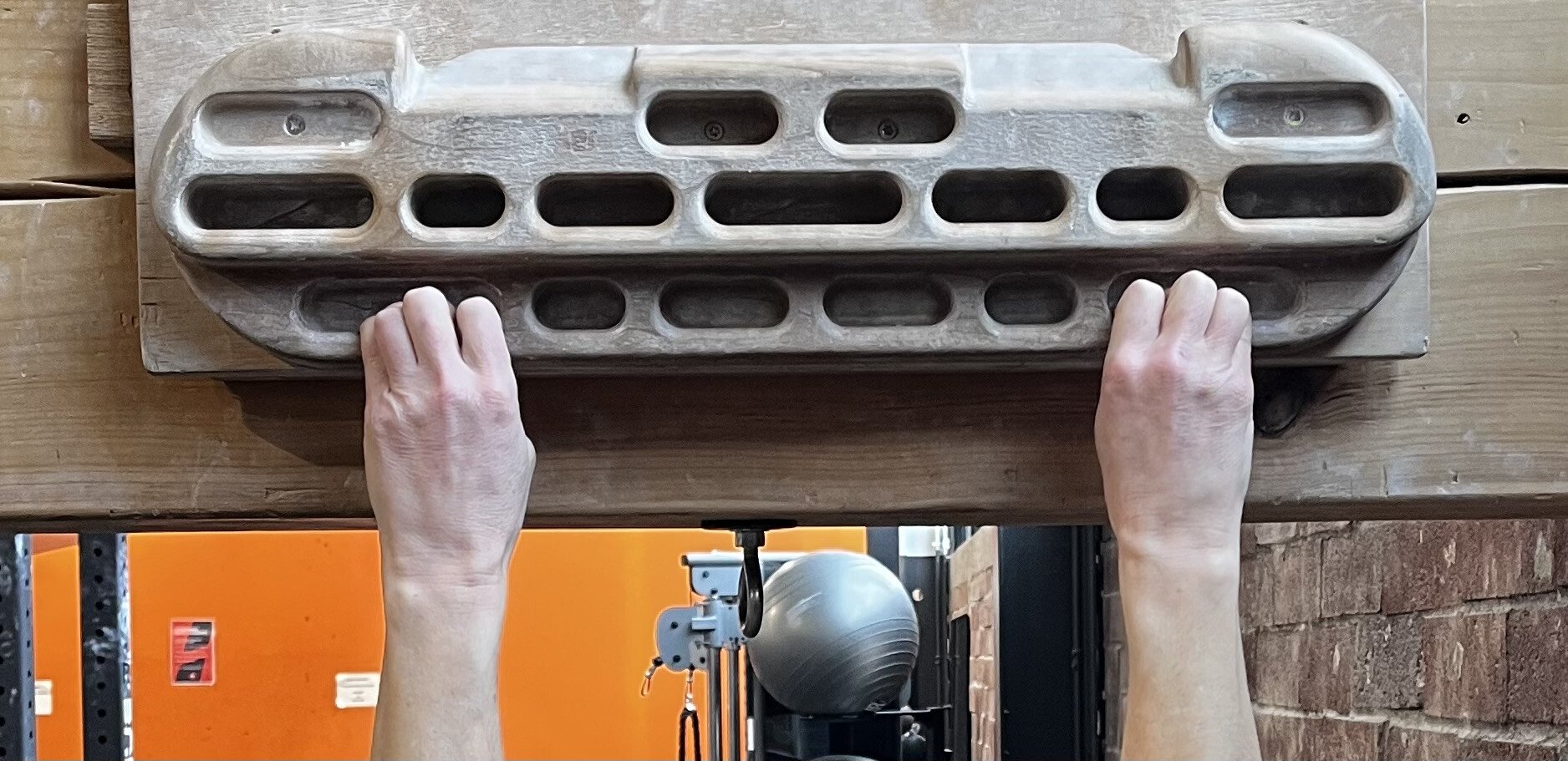
Hang boards, first introduced in late 1986, are wooden or molded-resin boards
(usually about a foot high by 2 ½ feet long) that are mounted up high like a pull-up bar.
— John Long, How to Rock Climb! (1989)
Why would anyone want to hang from their fingertips? Is this some sort of masochistic torture device?
This is what I wondered the first time I saw a fingerboard in 1994. The contraption was set into the rafters of the dingy old basement of the house Brian lived in on campus where we both went to college. My encounter with this device occurred within weeks of beginning to climb regularly outdoors.
Brian and I traveled south for four hours from school to the New River Gorge in West Virginia to climb every weekend. Each Saturday and Sunday, I would struggle my way up routes that Brian set up top ropes on, easy routes that were very hard for me since I was pretty much built like a wet noodle— kind of soft and mushy— and had only given up smoking cigarettes a bit more than a year earlier.
Three weeks into this new life, and I began waking up in the middle of a weekend night with my elbows throbbing in pain after climbing all day. It hurt so bad that I couldn’t bear to pull on anything. On Labor Day weekend, I went along with Brian anyway, just to be with him, stand around belaying him, and watching him and everyone but me climb. Even maneuvering the rope through the belay device and keeping Brian safe and alive hurt my poor elbows.
This was not good. Was I going to have to quit? I had just gotten started!
“Maybe you should talk to an athletic trainer when we get back,” Brian suggested after I spent the whole weekend whining about it.
“Athletic trainer? What the hell is an athletic trainer going to be able to tell me?” I was by no means the kind of person who talked to an athletic trainer. I was not an athlete. I was very skeptical that this athletic whosie-whatsit would give me the time of day, much less, helpful advice.
“His job is to know how to diagnose pain and keep the school’s athletes healthy.”
“Oh.”
Brian and I went to the campus gymnasium to talk to the trainer for the soccer team— Brian had been a soccer player his freshman and sophomore years— after lunch one day. When I told him what was happening and showed him where I was experiencing pain, without thinking for more than 15 seconds, the trainer said that I was resting too much in between climbing on the weekends. My muscles were atrophying somewhat during the week, so that when we went climbing, my tendons were taking the bulk of the load because my muscles were still weak and puny. He told me I needed to climb, or some similar activity, once or twice in the middle of the week— I needed to use these muscles more, not less, to get them stronger. Then my tendons would stop being inflamed and pissed at me.
Too much rest? What a concept!
“I have just the thing,” Brian said.
Enter the fingerboard in the stinky, musty basement. Brian was the proud owner of a Metolius Simulator, made out of the same plastic as the climbing holds in the gym. It was a single, rectangular hunk with all different sizes of edges and holds molded into it: a set of jugs that you could wrap your whole hand around; round slopers that keep your hands open and required contact strength from your skin; a bunch of different sized sets of pockets for one finger, two fingers or three fingers; and edges for your fingertips, starting large (1.5”) and gradually getting smaller (0.5”).
Once a week we would go down to the basement together and workout. The hangboard came with easy, intermediate, or advanced ten-minute workouts— one to two hangs and/or pulls on a different hold per minute, which was supposed to mimic the hanging and pulling a person would do on a rock climb.
Here’s an example of an easy ten-minute workout stolen from Metolius.com almost 30 years later; it’s likely the same as the one I did in 1994.
Time | Exercise, Hold Type |
1st minute | 15 second hang, Jug |
2nd minute | 1 pull-up, Round Sloper |
3rd minute | 10 second hang, Medium Edge |
4th minute | 15 second hang w/ 3 shoulder shrugs, 3-finger Pocket |
5th minute | 20 second hang w/ 2 pull-ups, Large Edge |
6th minute | 10 second hang, Round Sloper 5 knee raises, Pocket |
7th minute | 4 pull-ups, Large Edge |
8th minute | 10 second hang, Medium Edge |
9th minute | 3 pull-ups, Jug |
10th minute | Hang as long as you can, Round Sloper |
Music played from the boombox in the dark, dirty corner, probably one of Brian’s famous mixed tapes: songs by Toad and the Wet Sprocket, Matthew Sweet, Mazzy Star, The Violent Femmes, perhaps. While Brian did his workout— usually intermediate or advanced— I would rest and keep time, and vice versa. I could barely attempt the easy workout. I couldn’t do anything resembling pull-ups or full deadhangs— hanging from your fingers with all your weight— yet, so I set my feet on a chair to take some of the weight off my floppy, rag doll arms. By the end of the workout, the soft, baby skin on my fingers and hands would end up red and irritated from the somewhat rough texture of the holds.
The lingering memory of these workouts is not that they were fun, but that using this torture device once a week did the trick. It was the magic bullet, the panacea, the antidote, the cure. My elbows calmed down and stopped hurting. My fingers and muscles grew stronger. I developed tougher, calloused skin. After a couple of weeks, I could hang holding all my weight for the allotted amount of seconds, and after a few months I could do one unassisted pull-up— depending on moon phase and planet alignment, of course. More importantly I could climb outside on the weekends again without being in excruciating pain.
Using the fingerboard was the first time I was disciplined about training a skill of my own volition. It was a sign that I was serious about climbing. John Long says, “Few climbers, even those who take it seriously, are motivated enough to train regularly with climbing in mind.”
Who was this new kind of person I was becoming? I was doing so many things I had never even wanted to do. I liked camping and being outside and not showering, and now I was spending time in a dark and ugly place to do these repetitive, monotonous training exercises. Breathing in and out. Counting endlessly, over and over again. Where was this determination coming from? It was like I had never loved anything at all before this. And now look at me, hanging from my finger tips voluntarily.
Times have changed since 1994, but the fingerboard is still a part of my climbing story 30 plus years later. As a tool for maintaining and training finger strength when you don’t have time to climb or as a supplement to climbing, it is still indispensable. As an older climber, one of my favorite things to do on the hangboard these days is No Hangs. “No hangs” means you are holding onto the fingerboard, but keeping your feet on the ground to take some of the load off. You “no hang” on your fingers with only 40-60% of your body weight. I do a 12 minute workout, not hanging for 10 seconds at the top of a minute and resting the remaining 50. Three no hangs for each hold type: half-crimp, three-finger drag (open hand), back three drag. Then one no hang each: middle two, front two, mono. This workout can be done once or twice a day, every day. It’s also a good warm up before climbing. I say it’s like taking your fingers for a walk, like active rest that is actually better recovery than inactive rest. Surprisingly, it’s kind of like I’m right back where I started, back in the day when I had to put my feet up on the chair to take weight off. However, the experts are learning that it is actually possible to gain finger strength over a period of time with this gentle workout. Less can actually be more, in this case. I can’t explain it so here is a 13 minute video on the “science” behind the No Hang protocol. Or, you can read more about it here and here.
There are a multitude of other ways to use the fingerboard, from aggressive for the expert wanting to push limits to gentle for the amateur wanting to hang on longer or learn how to do pull ups. You can find workouts on the Crimpd app and at ClimbStrong.com, as well as the companies who make finger training apparati: Metolius, Beastmaker, Tension, to name a few. You can find these boards and others at the ASCEND gyms in the workout areas. It can also become a tool for injury if a climber's approach to using it is not conservative. Be careful when you train your teeny tiny finger tendons! If you are new to climbing or new to training, it is probably a good idea to consult with a coach or someone you know who is an experienced climber.